
Introduction
At the middle of the 20th century, it appeared that liberalism was unstoppable in America, with President Dwight Eisenhower famously making peace with the New Deal and President Lyndon Johnson’s landslide election in 1964 promising Americans the “Great Society.” The United States seemed to be going in the direction of a managed economy, social democratic policies, and social tolerance.
And then it all changed. The conservative right, in the shadows for generations, came roaring back, largely due to the growing wealth of the suburban white middle class and its resentment towards expanding civil rights. From Barry Goldwater to Ronald Reagan, the right’s new energy, focus, and unflinching drive towards dominance completely reshaped American life, and we are still living in the world it made.
How did we get to this place? To answer that question, historian and journalist Rick Perlstein dug into the archives—reading newspapers, magazines, and other primary sources—to tell this story. The result was a four-volume history of the rise of the modern conservative movement in America, from Goldwater’s 1964 presidential run, to Nixon’s rise and fall, and finally to Reagan’s electoral triumph in 1980.
Perlstein weaves together varying strands of historical knowledge, such as economics, foreign policy, cultural trends, and even religious transformations. And as a man of the liberal left, Perlstein pulls no punches with the political order that emerged in the era of his study. Goldwater was a political neophyte; Nixon a calculating bully; and finally Reagan, whose outsized presence in history stands as the culmination of the corporate class’s victory over social democracy in America.
Reading his books is both a joy, in that he’s a skillful and entertaining writer, and infuriating, as you discover the political center of America veering sharply to the right as a result of corporate sociopaths, political mountebanks, and religious fanatics. Perlstein provides you with reassurance that you’re not crazy, that the last 50 years have played out as they have, and that the world we live in now is largely defined by this history.
Below are the four short reviews I wrote about Perlstein’s history of the modern American right. I hope that it’ll encourage you to check out the work of an inimitable voice in popular history.
Before the Storm (2001)
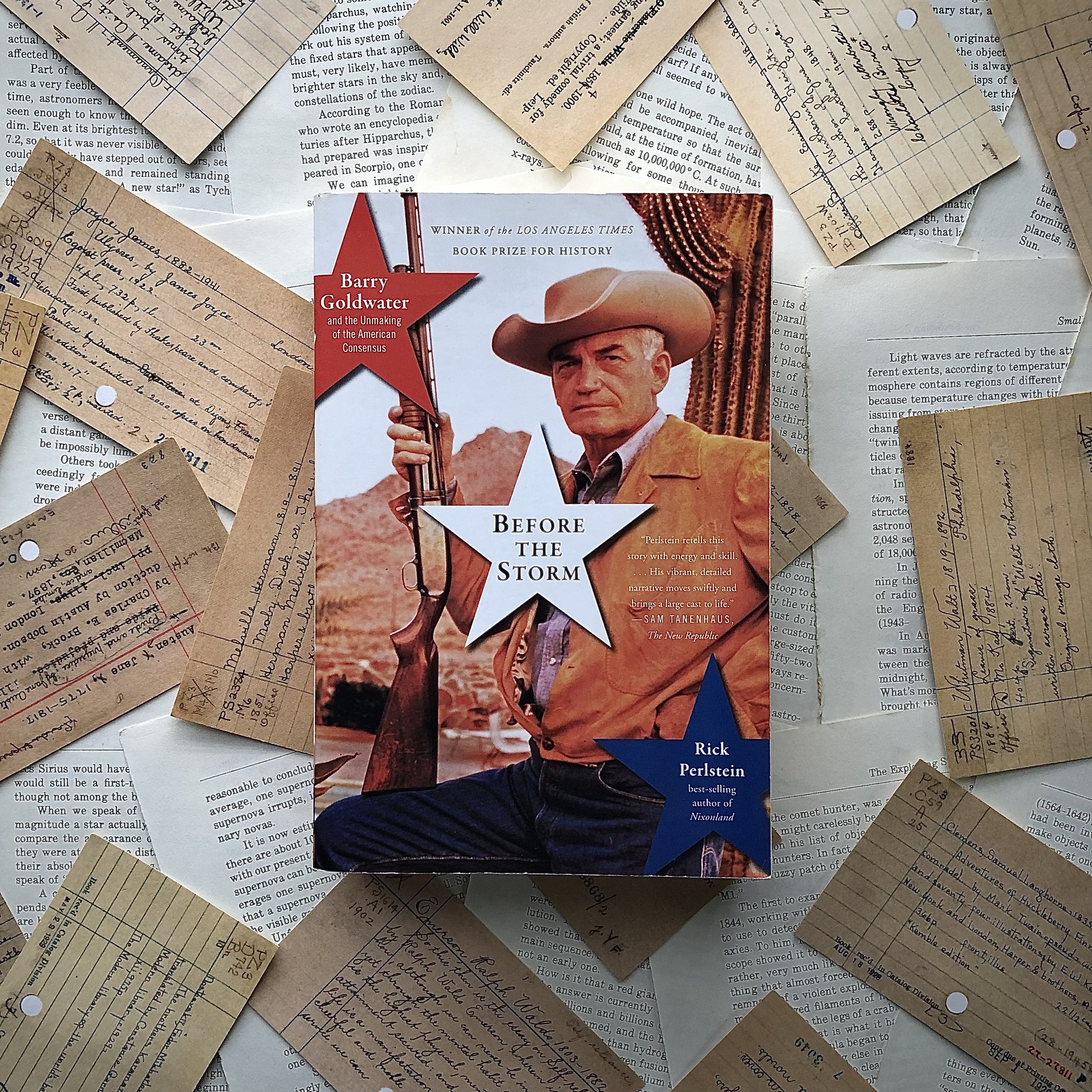
After World War II, the United States entered into an “era of consensus” where major political leaders, from both parties, accepted and even expanded the New Deal political framework of President Franklin Roosevelt. It seemed as if conservatism, out of power for decades, was an outmoded and even moribund ideology in America. What the political class didn’t see coming was an Arizona senator who put the political right back on the map, despite losing crucial battles.
Rick Perlstein chronicles this history in the first of his four-volume series on the rise of the modern American right, Before the Storm: Barry Goldwater and the Unmaking of the American Consensus. Arizona senator Barry Goldwater brandished a form of fiery conservatism that galvanized a nascent political movement and quickly pushed him to the upper echelon of American politics. Elected in 1952, his strident anti-communism and critique of the New Deal struck a nerve with suburban, white, middle class Americans, many of which, ironically, had benefited from the New Deal political order.
Goldwater was considered for the presidency as early as 1960, and after Richard Nixon’s defeat by John F. Kennedy that fall, the Republican party increasingly looked to him as their man for 1964. On the Democratic side, Kennedy’s assassination in 1963 gave Lyndon Johnson the presidency, and with it, the reins to the post-war political consensus, which he had spent years cultivating.
Through a mixture of feverish grass-roots support and cunning corporate maneuvering, Goldwater became the Republican nominee in 1964. This suited Johnson just fine, as he could use Goldwater’s hawkish foreign policy and anti-New Deal positions against him. And in the fall of 1964, Johnson beat Goldwater in one of the largest landslides in American history. Despite this defeat, Goldwater’s reshaping of the Republican party along his brand of conservatism would be essential to Nixon’s election in 1968 and Ronald Reagan’s in 1980.
Perlstein expertly handles the political, social, and cultural currents that made up such a defining period in American life, making Before the Storm a pivotal guide to the era.
Nixonland (2008)

Nixonland is the second of his four-volume narrative history of the rise of modern American conservatism. As the title indicates, this book focuses on Richard M. Nixon, the nation’s 37th president, as he navigates his way in the political tumult of the mid-to-late 1960s. Nixon, a master of political chicanery, used the divisions and upheavals of his era to secure the Republican Nomination in 1968, squeaking out a narrow victory against the Democratic nominee, Hubert Humphrey. From there, the book covers Nixon’s first term as president, from his escalation of the Vietnam War and legendary trip to China to his domestic war on dissenters and revolutionary politics.
While Nixon is at the center of this book, the chaotic Democratic primaries of 1968 and 1972 also play a large role, particularly Eugene McCarthy’s anti-war challenge to Lyndon Johnson, the campaign and assassination of Robert F. Kennedy, and the watershed candidacy of Senator George McGovern.
As with his previous book on Barry Goldwater’s rise in Republican politics, Perlstein masterfully uses primary sources like newspapers, magazines, and manuscript collections to craft an almost day-by-day account of this crucial era in American history.
However, to say this book is only narrative history would be a misstep. Perlstein is also a master of analysis, underscoring his historical narrative with probing insights into the era. So many of the divisions that exist in American society today, especially around race, class, and culture, stem from this period of time, and the author deftly weaves this point throughout the text. If you want to understand the early Nixon era and its continued relevance to our own time, definitely check out this book.
The Invisible Bridge (2014)

Ronald Reagan’s 1980 landslide victory over Jimmy Carter jump-started the conservative revolution in America, an era we still haven’t left. But did you know that Reagan nearly won in 1976, only two years after Watergate ended Nixon’s presidency and almost finished off the Republican Party? In The Invisible Bridge, Perlstein brilliantly captures what he calls “the fall of Nixon and the Rise of Reagan,” an era in the mid-1970s when American optimism was on the ropes, trust in government was at all-time lows, and the economy was sliding into a ditch.
After Nixon’s landslide reelection in 1972, the 37th President’s paranoia and hubris caught up with him, in the constitutional crisis that was the Watergate scandal. The public learned through investigative reporting and congressional testimony that the White House set up a division called the “Plumbers,” who had broken into the Democratic National Committee’s offices at the Watergate Hotel to steal information potentially damaging to Nixon’s opponent, George McGovern. Nixon’s own complicity in the crime, via attempts at a cover up caught on White House tapes, nearly led to his impeachment and ultimately his resignation from office, still the only president in history to do so.
At the same time, Ronald Reagan— B-movie actor, GE spokesman, and voice of American conservatism— was finishing his second term as the Governor of California and plotting his run for the White House. This all came to a head in 1976, when he challenged then-incumbent President Gerald Ford in the Republican Primary and nearly won the nomination at a raucous convention in Kansas City. His near-takeover of the Republican Party drastically shifted its center of gravity to the right, both on domestic issues like abortion and on foreign policy related to the Soviet Union.
While Reagan lost his battle to Ford (who was defeated in the general by Jimmy Carter), he ultimately won the war for the hearts and minds of the right and would lead a revolution four years later. Perlstein’s frenetic, encyclopedic narrative moves at a breakneck pace, and gives readers an indispensable look at a transitional era in modern American history.
Reaganland (2020)

The United States has never been the same since the election of Ronald Reagan to the presidency in 1980. His landslide victory over incumbent Jimmy Carter brought forth the conservative age that, in many respects, we’re still living through. But Reagan didn’t arise in a vacuum; his election to the oval office was presaged by many critical years of the conservative right building its organizations, honing its strategies, and sowing discontent in the nation.
In Reaganland, the fourth and final volume in Rick Perlstein’s series on the rise of modern American conservatism, we relive the crucial years of 1976-1980, an era marked by massive political, cultural, and social changes in which the new right thrived.
Jimmy Carter’s election over Gerald Ford in 1976 was supposed to bring about a new era of trust and openness between the government and the people, but the numerous crises he faced in the White House chipped away at those expectations. Runaway inflation, economic stagnation, energy shortages, and an Iranian hostage crisis challenged Carter’s time as president, with many believing he wasn’t up for the challenge. Some argued that Ronald Reagan should’ve been the one to take on Carter in 1976 and that he would’ve won.
During this same time, Reagan and the new right developed its own infrastructure for taking over American government, with the creation of political action committees (PACs), think tanks, direct mail operations, and brutal television campaigns that toppled liberal lions of the US Senate and a Democratic president. The religious right was also ascendant at this time, pushing the limits of their rhetoric against abortion and homosexuality and testing the limits of their tax-exempt status. This all culminated in Reagan’s staggering electoral victory over Carter, where he won 44 states and nearly 51% of the vote— with a coalition of evangelicals, disillusioned blue-collar workers, Wall Street elites, and suburban Democratic voters.
Perlstein’s impressive historical command of the era gives readers a front-row seat to one of modern American history’s most influential periods, making Reaganland arguably the best book in the series.