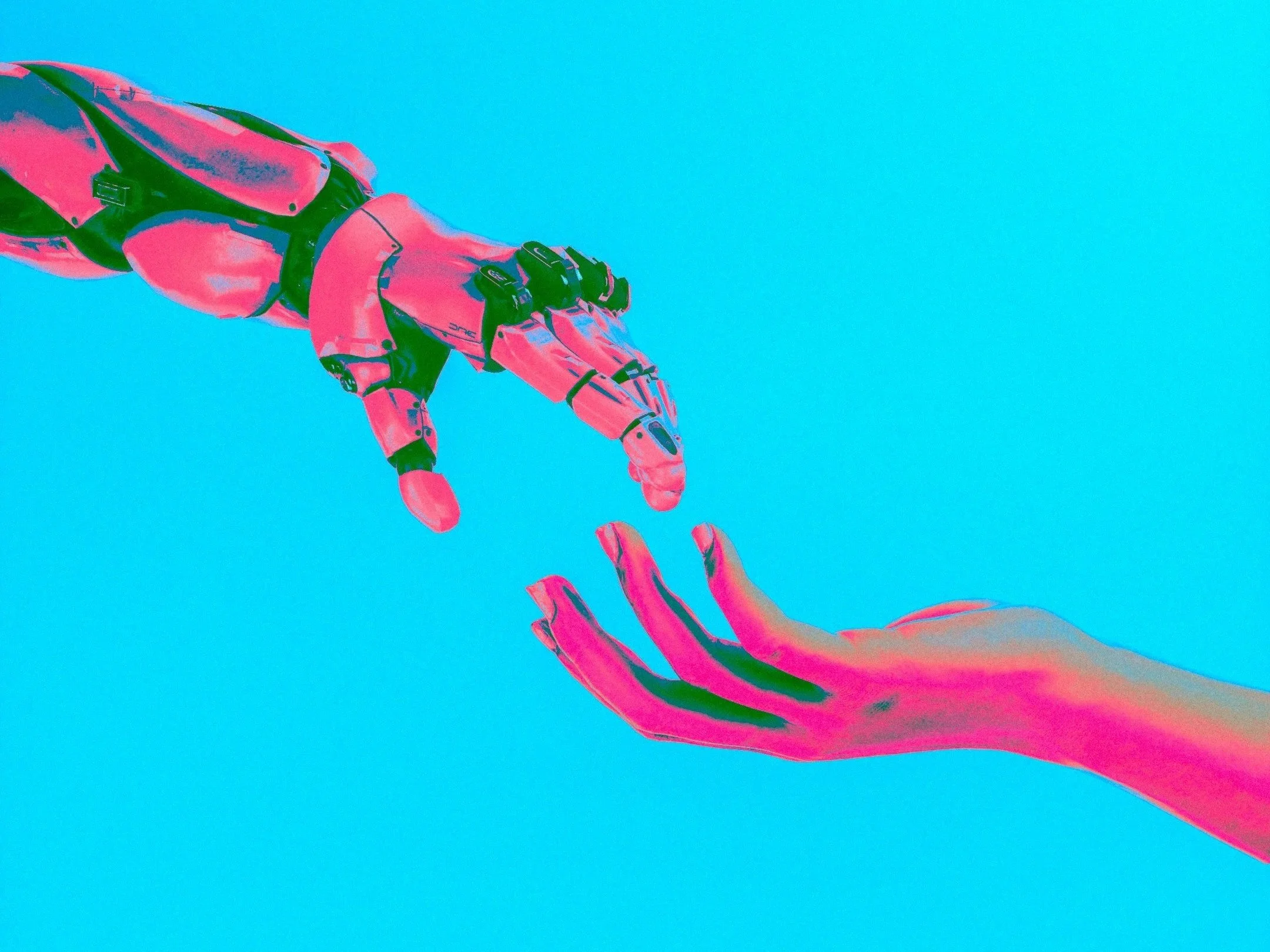
Asimov’s Three Laws of Robotics:
A robot may not injure a human being, or, through inaction, allow a human being to come to harm.
A robot must obey the orders given it by human beings except where such orders would conflict with the First Law.
A robot must protect its own existence as long as such protection does not conflict with the First or Second Law.
*
“Again, feeling doth prove that mind is born
Along with body, and with it step by step
Doth grow, and equally must waste with age.
For e’en as children totter with a weak
And tender frame, so doth a slender wit
Attend thereon; but as with riper years
Their strength doth wax, wisdom will grow apace
And force of mind gain increase. And at last,
When time’s stern strength hath sapped the frame, and loosed
Are all the limbs, their powers benumbed, anon
The wits are lamed, tongue raveth, mind is shaken,
All things give way and in one breath are fled.
‘Tis meet, then, that the nature of the mind
Should all be scattered likewise, e’en as smoke
Into the highflung breezes of the air;
Since side by side with body do we see
It brought to birth, and side by side they grow,
And worn with age together droop and fade.”
- Lucretius, On the Nature of Things, Book III
*
What makes humanity unique? Is it our opposable thumbs, which allow us to grasp our world in ways unknown to others? How about language? The mere fact that I can put these black, squiggly lines on a page—and that you, dear reader, can (hopefully) comprehend them—is nothing short of a miracle. What about our capacity for invention? We as a species can create new conceptions in the mind, which we can then craft from materials of the Earth. These are all astonishing things, without question, but I would argue that they aren’t the singular attribute that singles us out in the known universe. What makes humanity unique is something that most of us try to avoid thinking about at all: we know we’re going to die. No matter how well we take care of ourselves, no matter how much we invest in our futures, we all understand, deep down, that our futures slide toward oblivion.
In an age that promises expanded lifetimes and even the “singularity,” a melding of humans with technology for the purposes of immortality, grappling with the finality of death doesn’t seem like a topic for science fiction. But it was for science fiction legend Isaac Asimov. Fifty years ago, he wrote a story that tackled the subject head on with grace, humanity, and empathy: “The Bicentennial Man.” In this short but poignant tale, Asimov paradoxically reflects on the finality of death in a way that celebrates life, and ultimately concludes that consciously anticipating our death is what makes us fully human.
The story centers on Andrew, a robot who became an integral part of the Martin family who acquired him. Originally branded as a NDR (with a serial number he couldn’t remember), he took on the name Andrew because the youngest daughter of the Martins, whom he affectionately callsed“Little Miss,” decided to name him because she “could not use the letters, and all the rest [of the family] followed her in this.” He was supposed to be a simple, hospitality robot, who would cook, clean, and make the Martins their dinner. But he was so much more than that.
Jealous that her older sister received a special pendant as a gift, Little Miss asked Andrew to make her a pendant of her own using a piece of wood. The result was nothing short of extraordinary. Andrew beautifully crafted a pendant from the wood, so much so that the patriarch of the Martins, George (Andrew called him “Sir”) moved Andrew away from the tasks of housekeeping and towards learning the intricacies of woodworking. In a piece of dialogue from the story, Andrew actually shares his delight with the work to George.
“These are amazing productions, Andrew,” Sir soon told him.
“I enjoy doing them, Sir,” Andrew admitted.
“Enjoy?”
“It makes the circuits of my brain somehow flow more easily. I have heard you use the word `enjoy’ and the way you use it fits the way I feel. I enjoy doing them, Sir.”
This was the first experience of creativity, of happiness, and of freedom that Andrew would have in his long life, and the launching pad of his future as an independent being.
For years, Andrew made exquisite wooden furniture and sculptures, mastering the craft of woodworking. After some persuasive goading from Little Miss, Mr. Martin allowed Andrew to keep the earnings he received from his work, which later totaled hundreds of thousands of dollars. Andrew initially used this money to pay for improvements to his robotic body, which became numerous over the years, but then traded it all for the one thing he valued more than anything else: his freedom. “He doesn’t know what freedom is. He’s a robot,” George Martin said as an older man, but Little Miss wouldn’t budge. “Dad, you don’t know him. He’s read everything in the library. I don’t know what he feels inside, but I don’t know what you feel inside either. When you talk to him you’ll find he reacts to the various abstractions as you and I do, and what else counts? If some one else’s reactions are like your own, what more can you ask for?” The capacity for abstract thought is a cornerstone of sentient creatures, and its manifestation in Andrew showed that he was more than a mere robot.
In a stirring exchange between Andrew and a judge, the Martin family’s robot persuasively argues his case for freedom.
“Why do you want to be free, Andrew? In what way will this matter to you?”
Andrew said, “Would you wish to be a slave, Your Honor?”
“But you are not a slave. You are a perfectly good robot—a genius of a robot, I am given to understand, capable of an artistic expression that can be matched nowhere. What more could you do if you were free?”
“Perhaps no more than I do now, Your Honor, but with greater joy. It has been said in this courtroom that only a human being can be free. It seems to me that only someone who wishes for freedom can be free. I wish for freedom.”
And it was that statement that cued the judge. The crucial sentence in his decision was “There is no right to deny freedom to any object with a mind advanced enough to grasp the concept and desire the state.” It was eventually upheld by the World Court.
Andrew won his freedom, and lived the rest of his life as a free person who could chart his own course.
Over the decades, Andrew increasingly became more human, with the first step being wearing clothes. When a gang of youths accosted Andrew on the street while he was attempting to go to the library, it led to another inflection point in his journey of freedom. It was not enough to be a free robot; he also needed rights. George, Little Miss’ son, initiated a lawsuit on behalf of Andrew to secure his right from harm. During the trial, Andrew defended his need for rights, saying, “If a man has the right to give a robot any order that does not involve harm to a human being, he should have the decency never to give a robot any order that involves harm to a robot, unless human safety absolutely requires it. With great power goes great responsibility, and if the robots have Three Laws to protect men, is it too much to ask that men have a law or two to protect robots?” His persuasive argument led to the World Congress to pass a law securing robotic rights for the first time. In the end, Andrew’s advocacy solidified the need for rights that protected people’s freedom, regardless of their origins. This is a lesson from Asimov’s story that is more relevant today than when it was first written.
In time, Andrew would become the expert in robobiology and prosthetology, two fields of science that studied the development of robotic or synthetic devices that replaced human organs. His desire to pursue these fields was two-fold: he knew that the development of robotic organs would help prolong life in humans and, in turn, could be used as a means to making himself more human. The pursuit of robobiology proved to be a massive success for Andrew, which provided him the clout and the resources to change his entire physical makeup. He began to have synthetic skin that made him look human, developed a system for eating (which, in his case, was the ability to drink olive oil), and connected his positronic brain with organic nerve pathways that provided the ability to breathe and metabolize organic matter. With each advance of robobiology, Andrew improved the lives of countless people and drew himself closer to his ultimate dream: to become a human being.
He spent many years on the Moon, training and supervising a team of robots to install prosthetic organs into humans. They treated him not as a fellow robot, but as a human being, with freedom, agency, and dignity. It was during this experience that Andrew pushed towards his final act of advocacy: he wanted to be legally deemed a human being. As he argued to the head of the law firm the Martin family used to run, “I have the shape of a human being and organs equivalent to those of a human being. My organs, in fact, are identical to some of those in a prosthetized human being. I have contributed artistically, literally, and scientifically to human culture as much as any human being now alive. What more can one ask?”
This led to a partnership with a representative of the World Congress, Chee Li-Hsing, who campaigned for Andrew’s recognition as a human being for decades. At the same time, Andrew and his legal team carried forth lawsuits that, despite their defeats, would institute precedents that moved law towards Andrew’s goal. Despite all the progress made in his crusade for humanity, Andrew still needed an air-tight case for why he was human. He discovered that it ultimately rested on his positronic brain, something manmade and not a creation of biology. “It all comes down to the brain, then,” Andrew said cautiously. “But must we leave it at the level of cells versus positrons? Is there no way of forcing a functional definition? Must we say that a brain is made of this or that? May we not say that a brain is something—anything—capable of a certain level of thought?”
In thinking through the logic of his brain’s unique development, wherein it could theoretically last forever, he realized what he must do to assert his humanity: he must facilitate the end of his brain, and by extension, his entire body. In other words, in order to be recognized for having lived a human life, he had to die. As Andrew said to Representative Chee Li-Hsing, “See here, if it is the brain that is at issue, isn’t the greatest difference of all the matter of immortality. Who really cares what a brain looks like or is built of or how it was formed. What matters is that human brain cells die, must die. Even if every other organ in the body is maintained or replaced, the brain cells, which cannot be replaced without changing and therefore killing the personality, must eventually die.” Therefore, Andrew reconfigured his body so as to lead to the degradation of his positronic brain, which would allow him to die like a human being.
Mere days before he died, at the age of 200, Andrew Martin was deemed a human being by the World Congress, and a celebration was held in his honor. “Andrew was in a wheelchair. He could still walk, but only shakily,” Asimov wrote, “[and] with mankind watching, the World President said, ‘Fifty years ago, you were declared The Sesquicentennial Robot, Andrew.’ After a pause, and in a more solemn tone, he continued, ‘Today we declare you The Bicentennial Man, Mr. Martin. And Andrew, smiling, held out his hand to shake that of the President.” Shortly after the ceremony, as the fanfare died down, Andrew Martin’s positronic brain disintegrated and he died, surrounded by those who advocated for his cause. His final thought was of “Little Miss,” the young girl who two centuries before saw potential in him before anyone else. He had truly come full-circle.
Despite his voluminous writings on robotics, many of which touted the progress they could bring, Isaac Asimov actually harbored some reticence about their development and integration into human life. Some of this was informed by his own forward-thinking, humanistic philosophy, which grew out of his involvement with a group of writers known as the Futurians. As Manu Saadia has written, “the Futurians were unabashedly progressive. They believed that science fiction was much more than entertainment. They believed in its social utility and world-changing mission. They held it as a form of political weapon against obscurantism, fascism, and even capitalism. They viewed science fiction as an instrument of persuasion and social change.” Asimov saw his robot stories as a reflection of humanity’s connection to and reliance on technology, which could bring about progress or, as he explored in later works, ruin.
Asimov’s trajectory on the utility of robots “went from wholehearted embrace to caveat emptor and, ultimately, rejection.” In Robots and Empire, the final novel in his series of fictional works on robotics, humanity “settle[s] the galaxy the hard way, with no help from robots, with only their virtue and their bare hands.” How did Asimov come to this conclusion? As Saadia notes, some of it came from Asimov’s desire to connect his Robot series with his other pathbreaking science-fiction series, Foundation, the latter of which didn’t have robots at all. But that seems like a flimsy justification. In many respects, Asimov was applying his Futurian philosophy in a different way, envisioning progress for humanity as hampered by robotics rather than uplifted. He believed that automating everything in our lives would make us lose the promethean spark of creativity and drive, turning ourselves into willing accomplices of our own obsolescence.
That’s what makes “The Bicentennial Man” such a compelling story in Asimov’s Robot canon—the pinnacle of achievement for Andrew Martin wasn’t to become the smartest robot, or the most powerful robot, but something so elemental: he wanted to become human. His life was two centuries of striving towards imperfection, and ultimately, dissolution. As Andrew’s epoch-spanning transformation shows, a life that doesn’t have an end date is one not worth living. One would become a slave to perpetuity—facing the tyranny of time with no relief.
Isaac Asimov’s humanism finds a welcome complement in philosopher Martin Hägglund. His 2019 book, This Life: Secular Faith and Spiritual Freedom, advocates the same ethical commitment to a finite life that Asimov articulated in “The Bicentennial Man.” In fact, that’s how Hägglund defines “secular faith.” “The sense of finitude—the sense of the ultimate fragility of everything we care about—is at the heart of what I call secular faith,” he writes. “To have secular faith is to be devoted to a life that will end, to be dedicated to projects that can fail or break down.” It is only by fully embracing our fate as finite creatures that we can truly begin to be free. As Hägglund notes, “Only in light of the apprehension that we will die—that our lifetime is indefinite but finite—can we ask ourselves what we ought to do with our lives and put ourselves at stake in our activities.” Our lives are indefinite in their potential, but definitive in their conclusion. That is what makes secular faith a compelling view of life.
For Hägglund, secular faith has three major components. The first is what he calls an “existential commitment,” defined as “the faith that life is worth living is not caused by some vital force but is constituted by the commitment to a fragile form of life.” The second is “necessary uncertainty,” a dedication to a future and to others that isn’t set in stone. “In being committed to someone or something,” he writes, “I must have faith in the future and in those on whom I depend.” Finally, the precarious nature of a finite life instills a "motivational force” in us to live a meaningful life for ourselves and for others. As Hägglund elaborates, “part of what compels us to keep faith with what we love is our apprehension that the relation can be lost and thereby requires our fidelity.” These three pillars of secular faith—fragility of life, uncertainty in the future, and the motivating force of precarity—can impress upon us the joy and meaning that can be found in finitude.
With secular faith comes spiritual freedom, which “requires the ability to ask which imperatives to follow in light of our ends, as well as the ability to call into question, challenge, and transform our ends themselves,” Hägglund notes. Spiritual freedom calls upon us to define the ends we want to seek, whether it’s to excel in our career, start a family, or take up a social cause. It treats “the purposes of life,” according to Hägglund, “as normative rather than as natural. As a spiritual being, I am acting not simply for the sake of preserving my life or the life of my species but for the sake of who I take myself to be.” In essence, we are who we define ourselves to be.
While spiritual freedom can be grounded in an affirmative stance towards life, it can also be defined as a negative relation to one’s self. As he writes, “negative self-relation may be expressed as a crisis of existential identity—a conflict or breakdown in the relation among my different practical identities.” Sometimes our sense of self falls apart, especially in times of trial, like with the dissolution of friendships, combatting a serious illness, or the loss of a loved one. All of these trials, and our responses to them, define us in profound ways, shaping our identity and the parameters of our lives.
Finally, and most importantly, spiritual freedom, Hägglund argues, is “the ability to ask myself what to do with my time.” Most of us are fortunate to have free time, and this surplus is a precious resource, since we can often determine how to use it based on our values and our desires. Hägglund elaborates: “...as a spiritual being my relation to the surplus of time is inseparable from the question of how I should spend my time. This is the question that underlies all normative considerations, since what I do with my time is what I do with my life.” What we value, what we cherish, is determined by the time we devote to it. And making sense of how to use your time is impossible without the recognition that we all have a finite amount of time on this Earth. As Hägglund beautifully writes, “The indefinite time of my death is both what gives me the chance to prolong my life—to live on—and what makes it urgent to decide what I should do with my life. My death is therefore the necessary horizon of my life.” In choosing to die, Andrew Martin in “The Bicentennial Man” chose the “necessary horizon” of his life, and in doing so, illustrated what it truly means to be human.
It is not my intention to persuade people that the afterlife doesn’t exist. I don’t know if an afterlife exists. Whatever one believes on that question, based on their religious or spiritual worldview, is something I cannot adequately speak on. Nevertheless, what I do know is that this life, the one we all share on this small bit of dust in a vast cosmos, is the only life we’re guaranteed to have. As such, it’s important that we cherish this life, weather the storms of misfortune, and embrace the joy and freedom to be found in our finite lives. Embracing finitude made Andrew Martin the dynamic, free, and fully human person he became. We can, and should, make the same choice.
*
“Death is the greatest democrat in the world. It gets us all in the end, rich or poor, smart or dumb. The only thing to do is to relish the gift of life while it exists and to live each day to the full.”