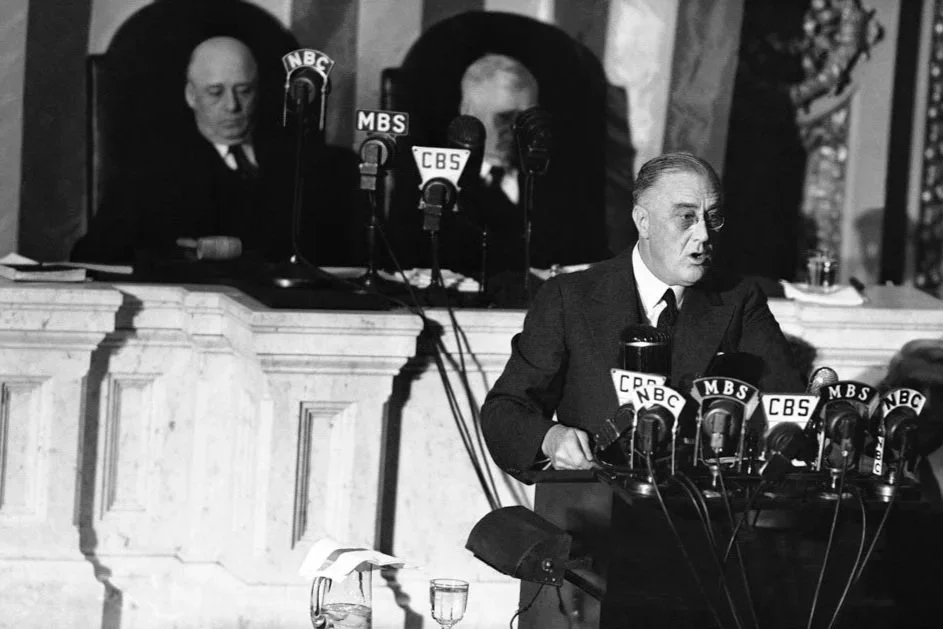
“Roosevelt's greatest service to mankind (after ensuring the victory against the enemies of freedom) consists in the fact that he showed that it is possible to be politically effective and yet benevolent and human: that the fierce left-and right-wing propaganda of the 1930s, according to which the conquest and retention of political power is not compatible with human qualities, but necessarily demands from those who pursue it seriously the sacrifice of their lives upon the altar of some ruthless ideology, or the practice of despotism — this propaganda, which filled the art and talk of the day, was simply untrue.”
- Isaiah Berlin, “Roosevelt Through European Eyes,” The Atlantic, July 1955
*
Last year, my wife and I visited Washington, D.C. during the nation’s fourth of July festivities. As I had been there multiple times, I served as a tour guide for both her and our friend. I took them through the majority of the National Mall, past military memorials for World War II, Korea, and Vietnam. I also showed them the memorials that have left the most lasting impression on the American people, such as the Lincoln Memorial, the Jefferson Memorial, and the more recent memorial for Dr. Martin Luther King, Jr. But it was one particular memorial that moved my wife more than any of the others: the memorial for the nation’s 32nd president, Franklin Delano Roosevelt.
Designed by famed architect Lawrence Halprin and opened in 1997, the FDR memorial is unlike any other memorial on the National Mall. While the Washington Monument and the Lincoln Memorial tower over their visitors—imposing their historical subjects on sightseers—the FDR Memorial is roughly one story tall, sprawling on the banks of the Potomac River much like the trees that envelop the space. The design was intentional. Roosevelt was paralyzed from the waist down due to the effects of contracting polio, so Halprin and other planners thought it was important for the memorial to be accessible to those in wheelchairs or with other disabilities. It has open rooms for FDR’s four terms, as he was the only president ever elected that many times, and inscribed on the granite walls are legendary quotes from the president, himself a legendary orator.
There is one wall that has always garnered my attention in the two times I’ve visited the memorial. It contains one of the most succinct and powerful statements of human freedom ever uttered by an American president, and its vision for the world embodies my own ideals. Inscribed on the wall are four simple phrases: “Freedom of Speech, Freedom of Worship, Freedom from Want, [and] Freedom From Fear.” These “Four Freedoms” came from a speech that FDR gave eighty-five years ago, on the eve of America’s involvement in the most disastrous conflict of the twentieth century. That speech articulated the meaning of those four freedoms, and in doing so would outline America’s commitment to its people, and to the world, for decades. It is through understanding this speech that we can find a renewed dedication to the promise of America.
On January 6, 1941, President Franklin Delano Roosevelt delivered an address to a joint session of Congress, otherwise known as a “State of the Union.” Having been reelected in 1940 amid the torment of war in Europe, Roosevelt was working tirelessly to prepare the United States for the moment when it must join its European allies against fascism. “During sixteen long months,” Roosevelt declared, “this assault has blotted out the whole pattern of democratic life in an appalling number of independent nations, great and small. And the assailants are still on the march, threatening other nations, great and small.” The rise of Mussolini in Italy, Hitler in Germany, Imperial Japan, and Stalin in the Soviet Union left many in the 1930s and 1940s wondering if a democratic way of life was going to prevail. This fragile moment in history is what made Roosevelt decide to run for a third term and to call for support for America’s allies in his address to Congress.
Having led the nation through the Great Depression of the 1930s, FDR and his New Deal reforms fundamentally reshaped the federal government’s role in people’s lives. By creating a new balance between the state and its citizenry, through social democratic means that provided expanded rights for workers, unemployment insurance, Social Security, and work relief programs, the New Deal placed dignity for all people at the heart of policy. By 1941, Roosevelt expanded this notion of dignity not just to Americans, but to all people. “Just as our national policy in internal affairs has been based upon a decent respect for the rights and the dignity of all of our fellow men within our gates,” he said, “so our national policy in foreign affairs has been based on a decent respect for the rights and the dignity of all nations, large and small. And the justice of morality must and will win in the end.” Roosevelt saw that dignity was at the heart of any meaningful conception of justice, whose conception shouldn’t be extended to only Americans.
To support America’s allies in Europe, particularly Great Britain, Roosevelt called for a program to provide armaments and materiel to the allies on a lending basis, to “make it possible for those nations to continue to obtain war materials in the United States, fitting their orders into our own program. And nearly all of their materiel would, if the time ever came, be useful in our own defense.” This would evolve into the “Lend-Lease” program, a core tenet of Roosevelt’s foreign policy until the United States entered the war in December of 1941. Obama speechwriter and author Ben Rhodes has written that “a few days after the speech, a bill creating the Lend-Lease program to extend support for allies was introduced in Congress; [and] within a few weeks, it passed, along with the largest defense appropriation in American history. This support fortified Britain through their resistance to the German blitzkrieg.” With Lend-Lease, America’s days as an isolated power were over, and the United States has played a fundamental role in the global political system ever since, for better or worse.
Yet, Roosevelt’s speech that January day is remembered less for specific policy prescriptions and more for his broader vision of freedom for both Americans and citizens of the world. It is towards the close of the speech that Roosevelt outlined his “Four Freedoms”:
In the future days, which we seek to make secure, we look forward to a world founded upon four essential human freedoms.
The first is freedom of speech and expression—everywhere in the world.
The second is freedom of every person to worship God in his own way—everywhere in the world.
The third is freedom from want, which, translated into world terms, means economic understandings which will secure to every nation a healthy peacetime life for its inhabitants—everywhere in the world.
The fourth is freedom from fear, which, translated into world terms, means a world-wide reduction of armaments to such a point and in such a thorough fashion that no nation will be in a position to commit an act of physical aggression against any neighbor—anywhere in the world.
Roosevelt’s idea of freedom was complex yet understandable, attentive to the heritage of our nation as well as its future.
The first two, freedom of speech and freedom of worship, are the foundational liberties enshrined in our Bill of Rights. They are what political philosopher Isaiah Berlin called “negative liberties,” meaning that they are freedoms that are protected from intrusion or degradation from government or any other entity. As Berlin put it, “I am normally said to be free to the degree to which no man or body of men interferes with my activity. Political liberty in this sense is simply the area within which a man can act unobstructed by others.” The freedom to think, write, publish, speak, and worship exist beyond an American sense of rights. They are human rights that undergird every other right or liberty we can claim as people. As Roosevelt said, “Freedom means the supremacy of human rights everywhere. Our support goes to those who struggle to gain those rights and keep them. Our strength is our unity of purpose. To that high concept there can be no end save victory.”
The second set of freedoms Roosevelt called for expanded the nature of freedom, from human rights granted to us in spite of government to social rights guaranteed by government. As such, they are called “positive liberties,” which Berlin defined as “the wish on the part of the individual to be his own master. I wish my life and decisions to depend on myself, not on external forces of whatever kind. I wish to be the instrument of my own, not of other men’s, acts of will. I wish to be a subject, not an object; to be moved by reasons, by conscious purposes, which are my own, not by causes which affect me, as it were, from outside.” “Freedom from want” ensures that a society takes care of its citizens to ensure better life for all, from food, shelter, and clothing to medical care, education, and other social services. As noted earlier, Roosevelt’s inclusion of this freedom came from his experience of being president during the Great Depression, when millions were unemployed, living in shacks, and barely had enough to eat. He believed in a world where those with less would never suffer the iniquities that had plagued his fellow citizens. Thus, when a person’s economic position is stable, their overall personal liberty increases. Put another way by another president, John F. Kennedy, “If a free society cannot help the many who are poor, it cannot save the few who are rich.”
The last was “freedom from fear,” meaning that a society protects not only its own but those who can’t protect themselves. In this freedom, Franklin Roosevelt and his successors established a liberal, internationalist order that kept the world largely peaceful for over 80 years. An international political order, with the United States at its center, should supply the military and diplomatic resources necessary to stave off conflicts and to ameliorate others from starting. Nearly every president since FDR has kept this promise, and in doing so, they have kept a foreign conflict from hitting our shores, with the exception of the horrific events of September 11, 2001. Even so, 9/11 rededicated the United States and its allies to the same principles that Roosevelt outlined in 1941— principles of cooperation, economic integration, and military preparedness. The United States hasn’t always gotten it right; it made horrific miscalculations like the wars in Vietnam and Iraq that set back the cause of human rights for all. But FDR’s principle stands. A world without fear, and one without armaments, is a world worth fighting for.
Now, let’s return to Isaiah Berlin’s notion of two concepts of liberty, which he developed in a highly influential essay from 1958. Written within the context of the Cold War, when the United States and the Soviet Union waged an ideological conflict—one of democracy and capitalism against autocracy and communism—Berlin’s essay ultimately sided with negative liberty against positive liberty. The latter liberty, to Berlin, could be dangerous in the wrong hands, as positive liberty asserts a higher form of life for humanity and not merely the removal of external threats to one’s human rights. But who defines that higher form of life? Ideally, it would be ourselves as individuals, but all too often it becomes the purview of the state, with awful consequences. As Berlin wrote:
But to manipulate men, to propel them towards goals which you—the social reformer—see, but they may not, is to deny their human essence, to treat them as objects without wills of their own, and therefore to degrade them. That is why to lie to men, or to deceive them, that is, to use them as means for my, not their own, independently conceived ends, even if it is for their own benefit, is, in effect, to treat them as subhuman, to behave as if their ends are less ultimate and sacred than my own.
The twentieth and twenty-first century’s record on the manipulation of human beings is almost without parallel. In the communist world, Stalin’s Soviet Union and Mao Tse-Tung’s China left millions dead from famine, political persecution, and the gulag, demonstrating the limitations of leaving the development of higher modes of living to the state. From the supposedly democratic world led by the United States, there were numerous crimes against humanity, from the overthrow of democratically-elected governments in Guatemala, Iran, and Chile to the death squads in Nicaragua and the indiscriminate bombing of Vietnam, Laos, Cambodia, Afghanistan, Iraq, and Gaza. Perhaps Berlin was right; trying to instill a sense of positive liberty would render negative liberty obsolete, and with it, the entire cause of human freedom.
Yet, as FDR’s example shows us, Berlin likely overstated the case about the negative consequences of positive liberty. For while the examples I shared above are true, it is equally true that the United States and the majority of the developed world created social democratic policies which vastly expanded positive liberty. Social Security, unemployment insurance, publicly-funded healthcare, welfare programs, protections for unions, and other forms of redistributive policies have lifted millions of people out of poverty and helped millions more live vastly better lives. These are examples of positive liberty in action that don’t diminish a person’s negative liberty. Freedom from want can provide the conditions for freedom of speech, freedom of religion, and freedom from fear.
Ultimately, Isaiah Berlin’s two concepts of liberty are not enough. There’s actually a third notion of freedom, one that integrates negative and positive liberty together: social freedom. Political philosopher Axel Honneth has been the most eloquent and persuasive proponent of social freedom, in books like The Poverty of Our Freedom. Regarding Berlin, Honneth wrote “that this bifurcation of the concept of freedom, which has developed under Berlin’s influence, is incomplete in a significant respect. The two models foreclose the possibility that the intentions of an agent can only be formed in reciprocal interaction between multiple subjects, and thus can be realized without coercion only by acting together.” By contrast, social freedom expands our conception of freedom to encompass everything which we collectively determine to be considered a component of freedom. As Honneth wrote, “To formulate one’s own intentions, one must be able to take up the perspective of others, and accept their potential corrective power. In this way democratic will-formation can be understood as a cooperative undertaking which serves the search for the common good.”
If this seems contrary to our American sense of freedom, look no further than the American philosopher John Dewey, who Honneth correctly notes as a propagator of social freedom. “John Dewey…argued throughout his life that individual freedom is falsely understood if it is exclusively understood as a capacity or possession of a solitary subject,” Honneth explained. “Rather, the degree of our freedom increases when we participate in socially cooperative activity, because we are better able to realize our intentions and wishes the more various the interactions in which we reckon with the responses and contributions of others.” Dewey even provided a definition of freedom that maps easily onto Honneth’s social freedom. As Dewey wrote in The Public and its Problems, “Liberty is that secure release and fulfillment of personal potentialities which takes place only in rich and manifold association with others: the power to be an individualized self making a distinctive contribution and enjoying in its own way the fruits of association.”
I would argue that Franklin Delano Roosevelt, and his conception of the “Four Freedoms,” also fits Honneth’s notion of social freedom perfectly. His social democratic vision, which combined the negative liberties of freedom of speech and religion with the positive liberties of freedom from economic deprivation and freedom from violent destruction, are predicated on a common vision of human wellbeing that is collectively developed by the social interaction of a unified society. In his 1941 address, Roosevelt even noted this common vision: “Since the beginning of our American history, we have been engaged in change—in a perpetual peaceful revolution—a revolution which goes on steadily, quietly adjusting itself to changing conditions—without the concentration camp or the quick-lime in the ditch. The world order which we seek is the cooperation of free countries, working together in a friendly, civilized society.” The emphasis on cooperation, on working together, to face the vicissitudes of modern life creates the conditions by which a just form of social freedom can develop.
In the closing of his speech to Congress in 1941, President Roosevelt emphasized that the Four Freedoms were “no vision of a distant millennium. It is a definite basis for a kind of world attainable in our own time and generation. That kind of world is the very antithesis of the so-called new order of tyranny which the dictators seek to create with the crash of a bomb.” His sense of urgency remains relevant today, as the world falls under the thrall of authoritarianism, economic protectionism, and a rejection of diplomacy to solve conflict.
In many ways, the world of our time exhibits exactly the kind of totalitarianism that Isaiah Berlin rejected in his essay on liberty. This seems important to note, as Berlin actually had a model of democratic leadership that he deeply admired—that of Franklin Delano Roosevelt’s. In an essay published years after the president’s death in 1945, Berlin called Roosevelt “the greatest leader of democracy, the greatest champion of social progress in the twentieth century.” Berlin applauded Roosevelt’s commitment to democracy, his advocacy of the welfare state, and his confident leadership during a time of supreme crisis. As he wrote:
Roosevelt's example strengthened democracy everywhere, that is to say the view that the promotion of social justice and individual liberty does not necessarily mean the end of all efficient government; that power and order are not identical with a strait-jacket of doctrine, whether economic or political; that it is possible to reconcile individual liberty—a loose texture of society—with the indispensable minimum of organising and authority; and in this belief lies what Roosevelt's greatest predecessor once described as 'the last best hope of earth.'
Roosevelt’s idea of social freedom protected individual rights while strengthening the social safety net that provides dignity and flourishing to all people of the United States, and served as a model for the world to follow.
And Roosevelt did all of this with a confidence and assurance that made Americans, and millions throughout the world, confident and assured in themselves. “He was one of the few statesmen in the twentieth or any other century who seemed to have no fear at all of the future, “Berlin wrote, “He believed in his own strength and ability to manage, and succeed, whatever happened.” Like Roosevelt, we should have no fear of the future. Our nation and the world face great challenges, from the decline of democracy to the threat of global climate change, but only if we face them with confidence will we have the capacity to solve them. America has often fallen far short of Roosevelt’s ideals; even his own administration fell short, through the internment of Japanese Americans and the continued segregation of the armed forces during World War II. But that doesn’t diminish the values that FDR fought for, ones we should take on as our own. It only strengthens our resolve to fight for the future, without fear of the future. Because a world without fear is a world worth fighting for.
*
“This Republic had its beginning, and grew to its present strength, under the protection of certain inalienable political rights—among them the right of free speech, free press, free worship, trial by jury, freedom from unreasonable searches and seizures. They were our rights to life and liberty.
As our Nation has grown in size and stature, however—as our industrial economy expanded—these political rights proved inadequate to assure us equality in the pursuit of happiness.
We have come to a clear realization of the fact that true individual freedom cannot exist without economic security and independence. ‘Necessitous men are not free men.’ People who are hungry and out of a job are the stuff of which dictatorships are made.”
- President Franklin Delano Roosevelt, “State of the Union Message to Congress,” January 11, 1944